Spotlight on: Wythenshawe
-
Over the last few months, we’ve been reflecting with our Partners on what is enabling their progress on the ground.
We’re seeing that the most impactful work is happening when we stop thinking in “school silos” and start focusing on the neighbourhood level.
We call this the "cluster" approach—moving from a system of vertical institutions to one of horizontal, local connection.
We’ve recently published two articles in our Fieldbook series that explore this shift in detail:
“The Mismatch” explores why even the best schools hit a "structural ceiling" when they work alone.
“Staking the Ground”looks at the "hardware" we need to build to make collaboration a reality rather than just a nice idea.
In this spotlight, we wanted to show what this looks like in practice. Read about leaders in Wythenshawe and their focus on rebuilding fundamental trust between the home and the school gate.
There are approximately 10,000 children living across the M22 and M23 postcodes in Wythenshawe, Manchester.
In October 2025, school leaders from Wythenshawe came together, across the boundaries of their individual school gates and trust membership, to map the terrain of the community they serve, and work out how they could better work together.
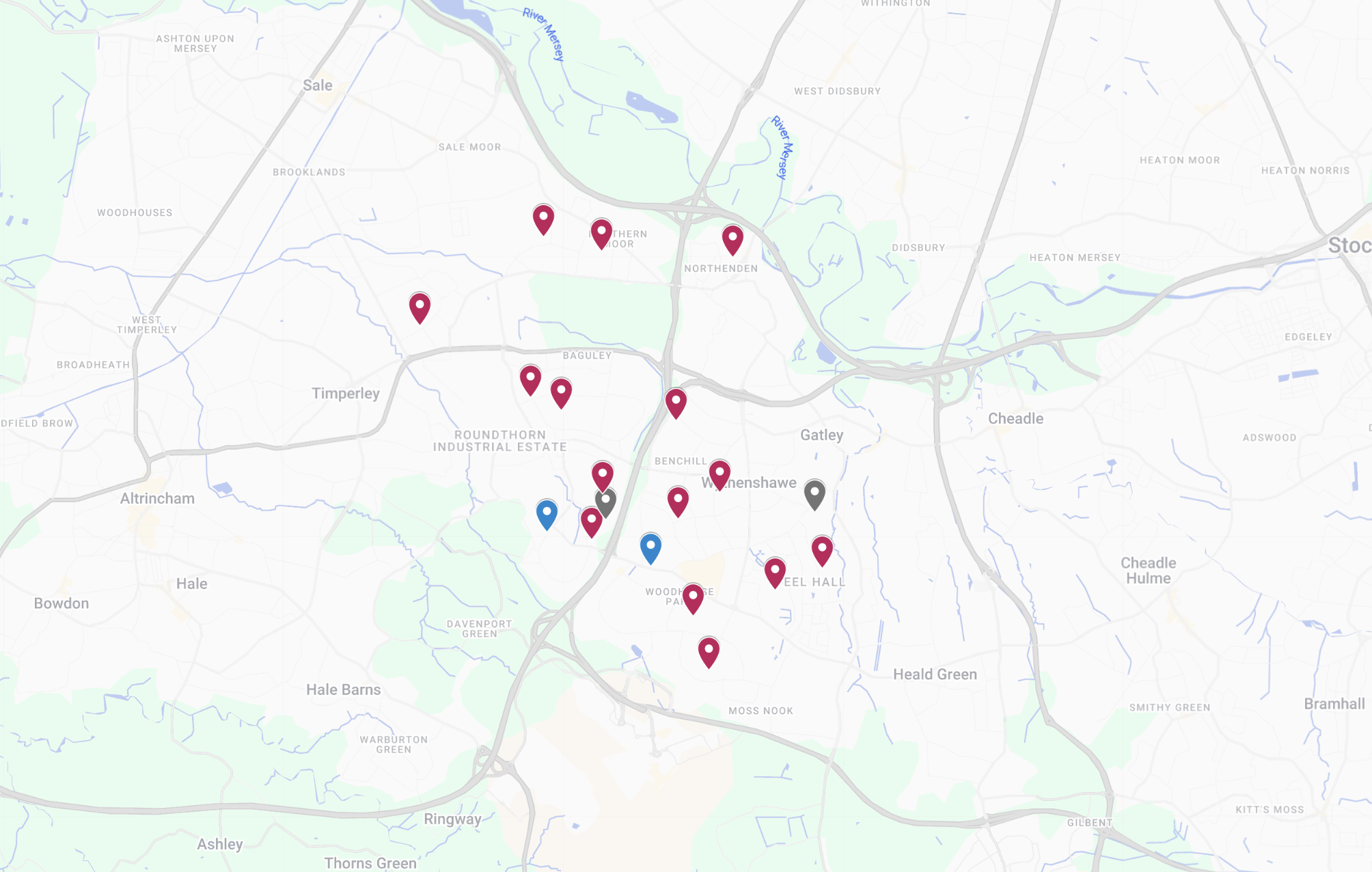
A map of educational institutions in Newquay (🔴 = Primary phase, 🔵 = Secondary, 🟢 = FE, ⚫️ = Other)
Their aim was to rebuild relationships with children and families that had come under increasing strain in recent years, manifesting in significantly lower school attendance than in other parts of Manchester.
As these leaders of two secondary schools and seven primary came together, in several cases, they were meeting in person for the first time. As they considered the story being told by a broad data set encompassing education outcomes, but also health, housing, employment and wellbeing measures, and mapped the many assets within the Wythenshawe community, they realised that whilst all of their individual school teams are working incredibly hard, the system itself was fragmented, and big shifts are required to join up their work.
We know that relationships are at the heart of this.
One headteacher gave an example of a member of her school team who recently left after 16 years working at the school. As soon as she left, their number of “no code” absences spiked significantly.
By listening to families, she learned that parents were only reporting their child’s absence because they felt comfortable speaking to Kay* (name changed), and once she left they stopped calling school.
Now, the new pastoral team member has prioritised visiting families’ homes and building a trusting relationship with them, and the number of ‘no codes’ has started to drop again.
Similarly, in starting to consider the big shifts required to transform the dynamic between schools and families in Wythenshawe, the first step was to build relationships between the group of headteachers and senior leaders themselves.
Seeing themselves as a team of leaders committed to children in Wythenshawe has enabled them to build an aspirational theory of change. They have moved from being individual leaders of their schools, to a team of leaders within their place with a shared vision and shared understanding of the status quo.
Their emerging priority is focused on families in Wythenshawe feeling well supported by schools to better support their own children—both by direct support from schools, but also wider services, with schools holding the relationship with families and joining up seamlessly with broader out of school support. Their hypothesis is that this will improve the trust and relationship between schools and families, leading to improved school attendance and educational outcomes for children in Wythenshawe.
It is early days, and this team is at the start of this work. But already there are green shoots showing. School reading leads are meeting across primary and secondary to start to cohere approaches to reading in years 5, 6, 7 and 8.
Leaders are working to build a cross-Wythenshawe guide for parents on a support offer for their children, and develop a plan for how to build parent confidence in using this guide effectively—so parents feel the school cares about them as parents, as well as their child, and is ‘showing care’ by supporting their access to the services they need.
This will involve producing the guide and sharing with parents, in tandem with planning intentionally relational parent-focused events in schools in Wythenshawe. They have a longer term goal to create a Wythenshawe specific SEND plan, and to better cohere approaches to in-year pupil transfers.
Underpinning all of this is a commitment to intentionally redesign school interactions with families—undertaking further work and training for their school teams on building strong relationships with parents on the philosophy that ‘every interaction is an opportunity’ to strengthen trust and relationships, looking at phone calls, home visits and calendared events through a family-centred lens.